
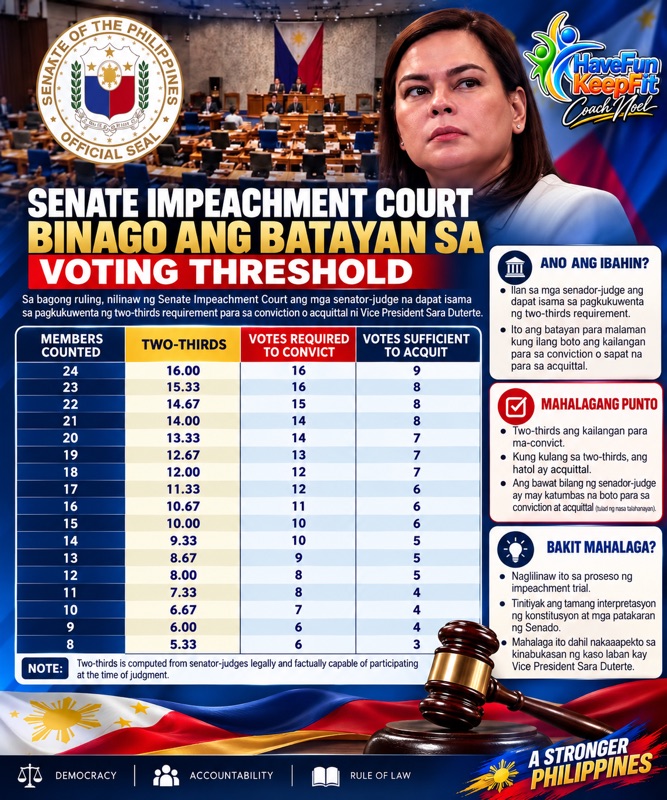
SENATE IMPEACHMENT COURT CHANGES THE BASIS FOR THE VOTING THRESHOLD
Sixteen votes are no longer automatically required for conviction
The Senate Impeachment Court made a significant change regarding the voting threshold in the impeachment trial of Vice President Sara Duterte.
Under the new ruling, the constitutional requirement of a two-thirds vote for conviction remains unchanged. What has changed is how the number of senator-judges used to calculate that two-thirds requirement will be determined.
What is the new basis?
Under the ruling, the two-thirds requirement will be calculated based on the number of senators who are legally and factually capable of participating in the impeachment proceedings at the time of the final vote.
This means that certain senator-judges may potentially be excluded from the calculation if they are detained or suspended, legally restrained from performing their duties, cannot be located by authorities, are physically or medically incapable of participating, are beyond the coercive processes of the Senate, or are in other comparable circumstances.
However, exclusion is not automatic. The Senate Impeachment Court must first determine, based on sufficient evidence, whether a senator falls under any of these circumstances.
What does this mean for the voting threshold?
It means that 16 votes may no longer always be the fixed number required for conviction.
The actual number needed would depend on how many senator-judges are legally and factually capable of participating when the final judgment is made.
For example, if all 24 senators are counted, two-thirds is 16 votes. If fewer senators are legally counted as capable of participating, the number required for conviction could also change.
Because senators cannot cast fractional votes, any two-thirds calculation that produces a fraction would effectively require the next whole vote to reach the constitutional threshold.
Why is this important?
The issue goes beyond whether the required number is 16, 15, or 14 votes. The central constitutional question is how the phrase “two-thirds of all the Members of the Senate” should be interpreted when one or more senators are legally or factually unable to participate as senator-judges.
Supporters of the new interpretation argue that the denominator should reflect senators who can legally and actually participate in the judgment.
Other senator-judges have taken a different position, arguing that the constitutional phrase “all the Members of the Senate” refers to the Senate’s full membership and therefore should not be reduced simply because some members cannot participate.
Ultimately, the exact voting threshold would depend on the composition and legal status of the senator-judges at the time the Senate Impeachment Court renders its final judgment.
SENATE IMPEACHMENT COURT BINAGO ANG BATAYAN SA VOTING THRESHOLD
Hindi na awtomatikong 16 boto ang kailangan para sa conviction
Isang mahalagang pagbabago ang ginawa ng Senate Impeachment Court noong September 23, 2026 kaugnay ng impeachment trial ni Vice President Sara Duterte. Sa botong 13–1, habang anim na senator-judges ang hindi lumahok, binaligtad ng korte ang naunang ruling na nagtatakda ng fixed 16 votes para sa conviction batay sa kabuuang 24 miyembro ng Senado.
Ano ang bagong batayan?
Sa bagong controlling ruling, nananatili ang constitutional requirement na two-thirds vote para sa conviction. Ang nabago ay kung sino ang isasama sa denominator o bilang ng mga senador na pagbabatayan sa pagkukuwenta ng two-thirds.
Ang bibilangin ay ang mga miyembro ng Senado na, sa oras ng final vote, ay “legally and factually capable of participating” sa impeachment proceedings.
Maaaring hindi isama sa denominator ang senator-judges na detained at/o suspended o legally restrained sa kanilang tungkulin; hinahanap ng mga awtoridad at hindi matukoy ang kinaroroonan; may physical o medical incapacity; nasa labas ng coercive processes ng Senado; o nasa iba pang katulad na sitwasyon. Gayunman, hindi awtomatiko ang exclusion—kailangang matukoy muna ng impeachment court, batay sa sapat na ebidensya, kung pasok ang isang senador sa mga naturang kategorya.
Ano ang epekto nito?
Ibig sabihin, wala nang permanenteng fixed number na 16 votes sa ilalim ng bagong ruling. Ang eksaktong bilang na kailangan para sa conviction ay nakadepende sa bilang ng senator-judges na legal at aktuwal na maaaring lumahok kapag ibinaba na ang final judgment. Kapag may fractional result sa two-thirds computation, kailangan itong umabot sa susunod na buong boto dahil walang fractional vote ang isang senador.
Mahalagang linawin na hindi nito binago ang two-thirds constitutional standard mismo. Ayon kina Senate President Sherwin Gatchalian at Senator-Judge Risa Hontiveros, ang binago ay ang voting base o denominator kapag may mga senador na hindi maaaring lumahok.
May mga senator-judges naman na tumutol sa interpretasyong ito. Ang kanilang posisyon ay ang constitutional phrase na “two-thirds of all the Members of the Senate” ay dapat tumukoy sa buong membership ng Senado at hindi dapat mabawasan dahil lamang may mga miyembrong hindi nakalalahok.
Bakit mahalaga ang ruling?
Ang usapin ay hindi lamang tungkol sa numerong 16, 15, o 14. Ang sentrong legal na tanong ay kung paano dapat unawain ang salitang “all” sa constitutional requirement kapag may mga senador na legal o faktuwal na hindi maaaring gumanap bilang senator-judges.
Sa huli, ang magiging aktuwal na voting threshold ay nakadepende sa komposisyon at legal na kalagayan ng mga senator-judges sa mismong panahon ng final judgment.
#SenatePH #SenateImpeachmentCourt #SaraDuterte #ImpeachmentTrial #VotingThreshold #Philippines #RuleOfLaw #PhilippinePolitics

No comments:
Post a Comment