
Wednesday, September 30, 2026

𝗛𝗨𝗪𝗔𝗚 𝗜𝗗𝗔𝗠𝗔𝗬 𝗔𝗡𝗚 𝗞𝗢𝗥𝗧𝗘 𝗦𝗨𝗣𝗥𝗘𝗠𝗔 𝗦𝗔 𝗠𝗚𝗔 𝗔𝗟𝗜𝗧𝗔𝗡𝗚 𝗣𝗔𝗠𝗣𝗨𝗟𝗜𝗧𝗜𝗞𝗔

​

Justice Noel Tijam tungkol sa kahulugan ng “All Members of the Senate,” pakikialam ng hudikatura, at pagprotekta sa kapwa senador

Nanawagan si retired Supreme Court Justice Noel Gimenez Tijam sa mga senator-judge na huwag nang paulit-ulit na dalhin sa Korte Suprema ang usapin tungkol sa interpretasyon ng katagang “All Members of the Senate” sa mga impeachment proceeding.

Ayon sa kanya, libo-libong mahahalagang kaso na ang kailangang resolbahin ng Korte Suprema sa loob ng mga itinakdang panahon. Sa halip na madagdagan pa ng mga usaping maaaring resolbahin batay sa malinaw na probisyon ng Konstitusyon, sinabi niyang dapat igalang ang oras at tungkulin ng pinakamataas na hukuman.

𝗔𝗡𝗚 “𝗔𝗟𝗟 𝗠𝗘𝗠𝗕𝗘𝗥𝗦 𝗢𝗙 𝗧𝗛𝗘 𝗦𝗘𝗡𝗔𝗧𝗘” 𝗔𝗬 𝗧𝗨𝗠𝗨𝗧𝗨𝗞𝗢𝗬 𝗦𝗔 𝗟𝗔𝗛𝗔𝗧 𝗡𝗚 𝟮𝟰 𝗡𝗔 𝗦𝗘𝗡𝗔𝗗𝗢𝗥

Para kay Justice Tijam, malinaw at walang kalabuan ang nasabing probisyon. Ang “all members of the Senate,” ayon sa kanyang interpretasyon, ay tumutukoy sa lahat ng 24 na senador.

Iginiit niyang naaayon ito sa kanyang pagbasa sa mga rekord at journal ng Constitutional Commission at sa probisyong kalaunan ay pinagtibay ng sambayanang Pilipino sa pamamagitan ng plebisito.

Dahil dito, para sa kanya, hindi na kinakailangang paliitin o baguhin pa ang kahulugan ng naturang probisyon.

𝗔𝗡𝗚 𝗞𝗢𝗥𝗧𝗘 𝗦𝗨𝗣𝗥𝗘𝗠𝗔 𝗔𝗬 𝗛𝗜𝗡𝗗𝗜 𝗗𝗔𝗣𝗔𝗧 𝗚𝗔𝗪𝗜𝗡𝗚 𝗧𝗔𝗚𝗔𝗣𝗔𝗠𝗔𝗚𝗜𝗧𝗔𝗡 𝗦𝗔 𝗔𝗟𝗜𝗧𝗔𝗡𝗚 𝗣𝗔𝗠𝗣𝗨𝗟𝗜𝗧𝗜𝗞𝗔

Pinaalalahanan din ni Justice Tijam ang mga senator-judge na ang pangunahing tungkulin ng Korte Suprema ay resolbahin ang mga usaping legal na nararapat dinggin ng hudikatura.

Sa kanyang pananaw, hindi dapat masayang ang oras ng Korte sa mga kontrobersiyang nagmumula lamang sa tunggalian at bangayang pampulitika.

Direkta ang kanyang panawagan: huwag nang dagdagan ang pasanin ng Korte Suprema at huwag nang palalain ang pagkadismaya ng sambayanang Pilipino.

𝗣𝗥𝗢𝗧𝗘𝗞𝗧𝗔𝗛𝗔𝗡 𝗔𝗡𝗚 𝗦𝗘𝗡𝗔𝗗𝗢 𝗔𝗧 𝗔𝗡𝗚 𝗠𝗚𝗔 𝗞𝗔𝗣𝗪𝗔 𝗦𝗘𝗡𝗔𝗗𝗢𝗥

Nanawagan din si Justice Tijam sa mga senator-judge na pangalagaan ang Senado bilang isang institusyon at igalang ang karapatan ng kanilang mga kapwa senador.

Ayon sa kanya, hindi dapat ituring na kalaban ang mga kapwa senador o basta alisin ang kanilang partisipasyon sa proseso.

Binigyang-diin din niya ang karapatan ng mga botanteng naghalal sa kanila. Para sa kanya, ang hindi pagpapalahok sa isang halal na senador ay maaari ring makaapekto sa representasyon ng mga mamamayang bumoto sa senador na iyon.

𝗕𝗔𝗞𝗜𝗧 𝗞𝗔𝗜𝗟𝗔𝗡𝗚𝗔𝗡𝗚 𝗔𝗕𝗔𝗟𝗔𝗛𝗜𝗡 𝗣𝗔 𝗔𝗡𝗚 𝗞𝗢𝗥𝗧𝗘 𝗦𝗨𝗣𝗥𝗘𝗠𝗔?

Kinuwestiyon ni Justice Tijam kung bakit kailangan pang hingin ang interpretasyon ng Korte Suprema sa mga salitang para sa kanya ay malinaw na.

Binanggit niya na maaaring tingnan ang mga karaniwang legal at English reference gaya ng Oxford English Dictionary, Black’s Law Dictionary, Merriam-Webster Dictionary at Roget’s Thesaurus, kasama ang mga journal ng Constitutional Commission, upang maunawaan ang kahulugan ng probisyon.

Sa huli, nanawagan siya sa mga senator-judge na pangalagaan ang Senado bilang institusyon, igalang ang kanilang mga kapwa senador, at huwag nang gawing bahagi ang Korte Suprema ng hindi kinakailangang bangayang pampulitika.

Para kay Justice Tijam, malinaw na ang nakasaad sa Konstitusyon. Ang hamon ngayon ay kung paano ito ipatutupad nang naaayon sa batas, proseso, at pananagutan sa sambayanang Pilipino.

Sa halip na personal na insulto laban sa mga senador, mas mahalagang suriin ng publiko ang kanilang mga boto, argumento, legal na batayan, at mga desisyong ginagawa nila sa prosesong ito.

𝗞𝗘𝗘𝗣 𝗧𝗛𝗘 𝗦𝗨𝗣𝗥𝗘𝗠𝗘 𝗖𝗢𝗨𝗥𝗧 𝗢𝗨𝗧 𝗢𝗙 𝗣𝗢𝗟𝗜𝗧𝗜𝗖𝗔𝗟 𝗗𝗜𝗦𝗣𝗨𝗧𝗘𝗦

Justice Noel Tijam on the meaning of “All Members of the Senate,” judicial intervention, and protecting fellow senators

Retired Supreme Court Justice Noel Gimenez Tijam called on senator-judges to refrain from repeatedly bringing before the Supreme Court disputes concerning the interpretation of the phrase “All Members of the Senate” in impeachment proceedings.

According to him, the Supreme Court already has thousands of important cases that must be resolved within prescribed periods. Rather than adding matters that, in his view, can be resolved through the clear provisions of the Constitution, he said the time and responsibilities of the country’s highest court should be respected.

𝗔𝗟𝗟 “𝗠𝗘𝗠𝗕𝗘𝗥𝗦 𝗢𝗙 𝗧𝗛𝗘 𝗦𝗘𝗡𝗔𝗧𝗘” 𝗥𝗘𝗙𝗘𝗥𝗦 𝗧𝗢 𝗔𝗟𝗟 𝟮𝟰 𝗦𝗘𝗡𝗔𝗧𝗢𝗥𝗦

For Justice Tijam, the provision is clear and unambiguous. According to his interpretation, “all members of the Senate” refers to all 24 senators.

He maintained that this interpretation is consistent with his reading of the records and journals of the Constitutional Commission and with the constitutional provision that was subsequently ratified by the Filipino people through a plebiscite.

For this reason, he believes there is no need to narrow or alter the meaning of the provision.

𝗧𝗛𝗘 𝗦𝗨𝗣𝗥𝗘𝗠𝗘 𝗖𝗢𝗨𝗥𝗧 𝗦𝗛𝗢𝗨𝗟𝗗 𝗡𝗢𝗧 𝗕𝗘 𝗠𝗔𝗗𝗘 𝗔𝗡 𝗔𝗥𝗕𝗜𝗧𝗘𝗥 𝗢𝗙 𝗣𝗢𝗟𝗜𝗧𝗜𝗖𝗔𝗟 𝗗𝗜𝗦𝗣𝗨𝗧𝗘𝗦

Justice Tijam also reminded the senator-judges that the Supreme Court’s principal responsibility is to resolve legal controversies that properly fall within the jurisdiction of the judiciary.

In his view, the Court’s time should not be unnecessarily consumed by controversies arising from political conflict and rivalry.

His appeal was direct: do not add unnecessarily to the Supreme Court’s burden or further contribute to the frustration of the Filipino people.

𝗣𝗥𝗢𝗧𝗘𝗖𝗧 𝗧𝗛𝗘 𝗦𝗘𝗡𝗔𝗧𝗘 𝗔𝗡𝗗 𝗬𝗢𝗨𝗥 𝗙𝗘𝗟𝗟𝗢𝗪 𝗦𝗘𝗡𝗔𝗧𝗢𝗥𝗦

Justice Tijam also called on the senator-judges to protect the Senate as an institution and respect the rights of their fellow senators.

According to him, fellow senators should not be treated as enemies or simply excluded from participating in the proceedings.

He also emphasized the rights of the voters who elected them. In his view, excluding an elected senator from participating may also affect the representation of the citizens who voted for that senator.

𝗪𝗛𝗬 𝗕𝗨𝗥𝗗𝗘𝗡 𝗧𝗛𝗘 𝗦𝗨𝗣𝗥𝗘𝗠𝗘 𝗖𝗢𝗨𝗥𝗧?

Justice Tijam questioned why the Supreme Court’s interpretation should still be sought for language that he considers clear.

He noted that standard legal and English references—such as the Oxford English Dictionary, Black’s Law Dictionary, Merriam-Webster Dictionary, and Roget’s Thesaurus—could be consulted alongside the journals of the Constitutional Commission in understanding the meaning of the provision.

In closing, he called on the senator-judges to protect the Senate as an institution, respect their fellow senators, and avoid unnecessarily drawing the Supreme Court into political disputes.

For Justice Tijam, the language of the Constitution is already clear. The issue now is how it should be implemented in accordance with the law, proper procedure, and accountability to the Filipino people.

Rather than resorting to personal attacks against senators, the public can examine their votes, arguments, legal grounds, and decisions throughout the proceedings.

#Justice #Constitution #ConstitutionalLaw #RuleOfLaw #Philippines #Senate #SupremeCourt #StandForTruth

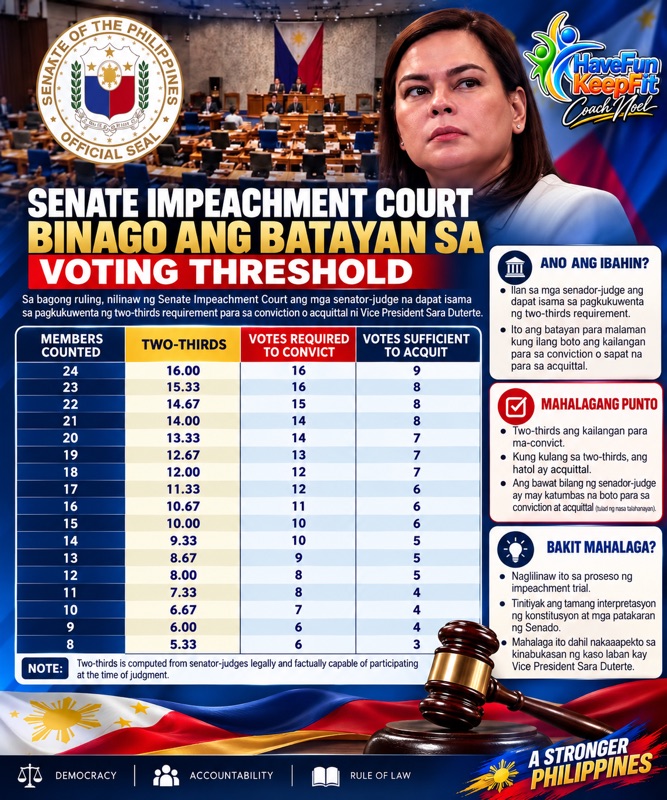

Wednesday, September 23, 2026

Senate Impeachment Court Voting System

​

SENATE IMPEACHMENT COURT CHANGES THE BASIS FOR THE VOTING THRESHOLD

Sixteen votes are no longer automatically required for conviction

The Senate Impeachment Court made a significant change regarding the voting threshold in the impeachment trial of Vice President Sara Duterte.

Under the new ruling, the constitutional requirement of a two-thirds vote for conviction remains unchanged. What has changed is how the number of senator-judges used to calculate that two-thirds requirement will be determined.

What is the new basis?

Under the ruling, the two-thirds requirement will be calculated based on the number of senators who are legally and factually capable of participating in the impeachment proceedings at the time of the final vote.

This means that certain senator-judges may potentially be excluded from the calculation if they are detained or suspended, legally restrained from performing their duties, cannot be located by authorities, are physically or medically incapable of participating, are beyond the coercive processes of the Senate, or are in other comparable circumstances.

However, exclusion is not automatic. The Senate Impeachment Court must first determine, based on sufficient evidence, whether a senator falls under any of these circumstances.

What does this mean for the voting threshold?

It means that 16 votes may no longer always be the fixed number required for conviction.

The actual number needed would depend on how many senator-judges are legally and factually capable of participating when the final judgment is made.

For example, if all 24 senators are counted, two-thirds is 16 votes. If fewer senators are legally counted as capable of participating, the number required for conviction could also change.

Because senators cannot cast fractional votes, any two-thirds calculation that produces a fraction would effectively require the next whole vote to reach the constitutional threshold.

Why is this important?

The issue goes beyond whether the required number is 16, 15, or 14 votes. The central constitutional question is how the phrase “two-thirds of all the Members of the Senate” should be interpreted when one or more senators are legally or factually unable to participate as senator-judges.

Supporters of the new interpretation argue that the denominator should reflect senators who can legally and actually participate in the judgment.

Other senator-judges have taken a different position, arguing that the constitutional phrase “all the Members of the Senate” refers to the Senate’s full membership and therefore should not be reduced simply because some members cannot participate.

Ultimately, the exact voting threshold would depend on the composition and legal status of the senator-judges at the time the Senate Impeachment Court renders its final judgment.


SENATE IMPEACHMENT COURT BINAGO ANG BATAYAN SA VOTING THRESHOLD

Hindi na awtomatikong 16 boto ang kailangan para sa conviction

Isang mahalagang pagbabago ang ginawa ng Senate Impeachment Court noong September 23, 2026 kaugnay ng impeachment trial ni Vice President Sara Duterte. Sa botong 13–1, habang anim na senator-judges ang hindi lumahok, binaligtad ng korte ang naunang ruling na nagtatakda ng fixed 16 votes para sa conviction batay sa kabuuang 24 miyembro ng Senado. 

Ano ang bagong batayan?

Sa bagong controlling ruling, nananatili ang constitutional requirement na two-thirds vote para sa conviction. Ang nabago ay kung sino ang isasama sa denominator o bilang ng mga senador na pagbabatayan sa pagkukuwenta ng two-thirds.

Ang bibilangin ay ang mga miyembro ng Senado na, sa oras ng final vote, ay “legally and factually capable of participating” sa impeachment proceedings. 

Maaaring hindi isama sa denominator ang senator-judges na detained at/o suspended o legally restrained sa kanilang tungkulin; hinahanap ng mga awtoridad at hindi matukoy ang kinaroroonan; may physical o medical incapacity; nasa labas ng coercive processes ng Senado; o nasa iba pang katulad na sitwasyon. Gayunman, hindi awtomatiko ang exclusion—kailangang matukoy muna ng impeachment court, batay sa sapat na ebidensya, kung pasok ang isang senador sa mga naturang kategorya. 

Ano ang epekto nito?

Ibig sabihin, wala nang permanenteng fixed number na 16 votes sa ilalim ng bagong ruling. Ang eksaktong bilang na kailangan para sa conviction ay nakadepende sa bilang ng senator-judges na legal at aktuwal na maaaring lumahok kapag ibinaba na ang final judgment. Kapag may fractional result sa two-thirds computation, kailangan itong umabot sa susunod na buong boto dahil walang fractional vote ang isang senador. 

Mahalagang linawin na hindi nito binago ang two-thirds constitutional standard mismo. Ayon kina Senate President Sherwin Gatchalian at Senator-Judge Risa Hontiveros, ang binago ay ang voting base o denominator kapag may mga senador na hindi maaaring lumahok. 

May mga senator-judges naman na tumutol sa interpretasyong ito. Ang kanilang posisyon ay ang constitutional phrase na “two-thirds of all the Members of the Senate” ay dapat tumukoy sa buong membership ng Senado at hindi dapat mabawasan dahil lamang may mga miyembrong hindi nakalalahok. 

Bakit mahalaga ang ruling?

Ang usapin ay hindi lamang tungkol sa numerong 16, 15, o 14. Ang sentrong legal na tanong ay kung paano dapat unawain ang salitang “all” sa constitutional requirement kapag may mga senador na legal o faktuwal na hindi maaaring gumanap bilang senator-judges.

Sa huli, ang magiging aktuwal na voting threshold ay nakadepende sa komposisyon at legal na kalagayan ng mga senator-judges sa mismong panahon ng final judgment. 

#SenatePH #SenateImpeachmentCourt #SaraDuterte #ImpeachmentTrial #VotingThreshold #Philippines #RuleOfLaw #PhilippinePolitics


Tuesday, September 22, 2026

THE PRECEDENT SET DURING THE CORONA IMPEACHMENT

​

Noong impeachment trial ni Chief Justice Renato Corona noong 2012, 23 lamang ang miyembro ng Senado dahil may isang bakanteng Senate seat. (Senate of the Philippines)

Bago pa man magsimula ang trial, malinaw ang naging posisyon noon ni Senate President Juan Ponce Enrile tungkol sa bilang ng boto na kailangan para sa conviction.

Ayon kay Enrile, 16 votes pa rin ang kailangan kahit bumaba pa sa 22, 20, o maging 17 ang bilang ng mga senador. Ipinaliwanag niya na ang pagbaba ng bilang ng sitting senators ay hindi awtomatikong nagpapababa sa 16-vote requirement. Sa kanyang interpretation, ang mga bakanteng puwesto o pagkawala ng senador ay effectively pumapabor sa respondent dahil nananatiling 16 ang kailangang boto para ma-convict. (web.senate.gov.ph)

At ito rin ang threshold na ginamit sa Corona impeachment.

Noong May 29, 2012, 20 senator-judges voted GUILTY while 3 voted NOT GUILTY, kaya nahatulan si Corona. Sa pag-anunsyo ng desisyon, sinabi ng Senate impeachment court na ang 20 guilty votes ay kumakatawan sa “at least two-thirds of all the members of the Senate.” (GMA Network)

Bakit mahalaga ito sa usapin ngayon?

Ang historical practice noong Corona trial ay mahalagang reference point sa debate kung paano dapat kwentahin ang constitutional requirement na “two-thirds of all the Members of the Senate.”

Kung 23 ang actual sitting senators, ang two-thirds nito ay 15.33, kaya kung actual membership ang pagbabasehan, kailangan pa rin ng 16 votes dahil hindi maaaring magkaroon ng fraction ng isang boto.

Pero mas mahalaga, hindi simpleng mathematical rounding lamang ang posisyon ni Enrile noon. Ang interpretation niya ay nakabatay sa constitutional Senate membership of 24, kaya sinabi niyang mananatiling 16 ang requirement kahit bumaba pa ang bilang ng senators. (web.senate.gov.ph)

Kaya ang tanong sa kasalukuyang debate ay hindi lamang:

“Ilan ang sitting senators?”

Kundi:

“Ano ang tamang constitutional meaning ng ‘two-thirds of all the Members of the Senate’ kapag may bakanteng puwesto o nabawasan ang aktuwal na membership?”

Ang Corona impeachment provides an important historical example of how the Senate handled that question in 2012. Gayunman, kung legal na “binding precedent” ba ito para sa isang kasalukuyang impeachment proceeding ay hiwalay na constitutional question na maaaring pagtalunan.

History gives us the record. The Constitution determines the rule.

#CoronaImpeachment #Impeachment #PhilippineSenate #Constitution #TwoThirdsVote #PhilippinePolitics #LegalHistory #Senate


Monday, September 21, 2026

​

Batay sa 2025 Statement of Assets, Liabilities, and Net Worth (SALN), idineklara nina Pangulong Ferdinand “Bongbong” Marcos Jr. at First Lady Liza Araneta-Marcos ang ₱475,931,289.93 na net worth, at wala silang iniulat na liabilities. Sa hiwalay na professional appraisal na kalakip ng SALN, tinatayang ₱1.029 bilyon ang fair market value ng kanilang real properties at ₱427.419 milyon ang personal properties—kaya umabot sa humigit-kumulang ₱1.457 bilyon ang kanilang kabuuang appraised net worth. 

Samantala, ayon sa 2025 SALN ni Vice President Sara Duterte, ang pinagsamang net worth nila ng kanyang asawang si Atty. Manases Carpio ay ₱98,656,131.20. Nakasaad din sa filing ang humigit-kumulang ₱122.8 milyon na assets at ₱24.14 milyon na liabilities. 

Mahalagang linawin na hindi direktang maihahambing ang ₱1.457 bilyong professionally appraised net worth ng Marcos couple sa ₱98.656 milyong declared SALN net worth ng Duterte-Carpio couple dahil magkaiba ang valuation basis. Kung declared SALN net worth lamang ang paghahambingin, ang figures ay ₱475.93 milyon kumpara sa ₱98.66 milyon. 

Parehong may nakatalang business interests at iba pang financial interests ang dalawang mag-asawa sa kani-kanilang disclosures. Sa kaso nina Duterte at Carpio, ang kanilang mga business interests ay naging bahagi rin ng pagsusuri sa mga SALN na iniharap sa mga pagdinig noong 2026. 

Sa usapin ng SALN, mahalagang paghiwalayin ang declared value, current appraised value, assets, liabilities, at net worth upang maging patas at tama ang paghahambing.

Ang SALN ay mahalagang instrumento para sa transparency at accountability ng mga opisyal ng gobyerno. Pero sa paghahambing ng yaman, kailangang malinaw kung declared SALN value o professionally appraised value ang ginagamit. Hindi dapat paghaluin ang dalawang magkaibang valuation basis dahil maaari itong magbigay ng maling impresyon.

Sa huli, hindi lamang laki ng net worth ang mahalagang tingnan. Mas mahalaga ang malinaw na disclosure ng assets, liabilities, business interests, at pinagmulan ng yaman alinsunod sa batas. Hayaan nating ang verified records at dokumentadong impormasyon ang magsilbing basehan ng ating pag-unawa.


Mention:

President Ferdinand “Bongbong” Marcos Jr. • First Lady Liza Araneta-Marcos • Vice President Sara Duterte • Atty. Manases Carpio • Statement of Assets, Liabilities and Net Worth (SALN)

Hashtags:

#SALN #NetWorth #Transparency #Accountability #Philippines     

Follow:

Follow for more verified news, public-record explainers, and updates.

HaveFunKeepFit | Coach NoelInCaseYouMissedPH

Comment:

💬 Ano ang pinakamahalagang impormasyon na dapat tingnan sa SALN—assets, liabilities, business interests, o pagbabago ng net worth? Share your thoughts respectfully below.

Wednesday, September 16, 2026

CHIZ ESCUDERO SEEKS CLARIFICATION ON “PARTICIPATE IN ANY BUSINESS” DURING IMPEACHMENT TRIAL

​


A constitutional question took center stage during the September 14, 2026 impeachment proceedings involving Vice President Sara Duterte: How broad is the prohibition against the President and Vice President participating in business while holding office?

During the proceedings, Presiding Officer Sen. Francis “Chiz” Escudero questioned retired Sandiganbayan Presiding Justice Amparo Cabotaje-Tang, who appeared as an expert witness, about the meaning of the phrase “participate in any business” under Article VII, Section 13 of the 1987 Philippine Constitution.

The provision states, in part, that the President, Vice President, members of the Cabinet and their deputies or assistants shall not, during their tenure, “directly or indirectly, practice any other profession, participate in any business, or be financially interested in any contract with, or in any franchise, or special privilege granted by the Government.”

One of the issues raised was whether “participation” refers only to actively managing or operating a business—or whether ownership, shareholdings and other financial interests may also fall within the constitutional restriction.

Cabotaje-Tang explained during her testimony that participation could be direct or indirect and discussed circumstances involving ownership of shares and positions as a corporate director or officer. She also addressed Escudero’s questions concerning whether divestment may be required even when the business interest involved is relatively small.

The exchange highlights an important constitutional issue: the restrictions placed on the country’s highest executive officials are intended to address potential conflicts between public duties and private financial interests.

The discussion formed part of the ongoing impeachment proceedings. Testimony and arguments presented during a trial should not by themselves be treated as a final determination of liability; that determination rests with the impeachment court under the applicable constitutional process.

For readers, the key question remains: Where should the constitutional line be drawn between simply owning an interest in a business and actually “participating” in that business?

Source: Proceedings of the Senate Impeachment Court, September 14, 2026.

#Philippines #ImpeachmentTrial #SenateImpeachmentCourt #ChizEscudero #SaraDuterte #1987Constitution #PhilippinePolitics #CurrentEvents


Tuesday, September 8, 2026

FILIPINOS ARE EVERYWHERE! ANOTHER FILIPINA SHINES AT THE US OPEN!

​

It’s not only Alex Eala representing Filipino pride on one of tennis’ biggest stages. Another Filipina, Bea Nikki Degoma, also earned her place on the courts of the US Open—this time as part of the tournament’s ball crew! 

Degoma was among the 300+ ball boys and girls selected to work at the prestigious Grand Slam tournament after reportedly making it through a highly competitive qualification process that started with around 3,000 applicants.

Imagine that—thousands tried, but only a few hundred earned the opportunity to step onto those famous courts. And among them was a Filipina! 

While Alex Eala continues to carry the Philippine flag through her tennis journey, Degoma’s achievement shows that Filipinos are making their mark in different roles behind the action as well.

From competing on the court to helping make the matches possible—Filipino pride is truly everywhere! 

Congratulations, Bea Nikki Degoma! Another inspiring Pinay making us proud on the international stage. 

📸 Photo credits to the respective owner/s.

Follow HaveFunKeepFit for more inspiring Filipino stories, sports updates, and trending news.

#BeaNikkiDegoma #AlexEala #USOpen #FilipinoPride #PinoyPride #ProudFilipino #FilipinosEverywhere #Tennis #InCaseYouMissedPH